Showing posts with label Socrates. Show all posts

Saturday, January 11, 2025

Socrates: Saya tidak bisa mengajari seseorang apa pun

Pernyataan Socrates, “Saya tidak bisa mengajari seseorang apa pun. Saya hanya dapat membuat mereka berpikir,” mencerminkan inti dari metode filsafatnya yang dikenal sebagai Metode Socratic atau dialektika. Berikut adalah penjelasan dari pernyataan ini:

1. Pendidikan sebagai Proses Pemahaman Diri
 • Socrates percaya bahwa pengetahuan sejati tidak dapat ditanamkan dari luar. Sebaliknya, ia harus muncul dari dalam diri seseorang melalui refleksi dan pencarian kebenaran.
 • Dalam pandangannya, tugas seorang guru atau filsuf bukanlah memberikan jawaban, tetapi membantu orang menemukan jawaban sendiri dengan berpikir kritis.

2. Metode Socratic
 • Socrates menggunakan metode tanya jawab yang mendalam untuk memandu orang mengevaluasi asumsi mereka, mengungkap kontradiksi, dan akhirnya mencapai wawasan baru.
 • Dengan cara ini, ia tidak “mengajari” dalam arti tradisional, tetapi memfasilitasi proses berpikir sehingga seseorang menemukan kebenaran secara mandiri.

3. Penekanan pada Otonomi Berpikir
 • Pernyataan ini juga menekankan pentingnya kemandirian intelektual. Menurut Socrates, hanya dengan berpikir secara mandiri, seseorang dapat mencapai kebijaksanaan sejati.
 • Pengetahuan yang dipaksakan dari luar tidak akan menghasilkan pemahaman mendalam atau perubahan yang bermakna.

4. Relevansi dalam Pendidikan Modern
 • Pendekatan ini sangat relevan dalam pendidikan saat ini, di mana guru diharapkan menjadi fasilitator yang mendorong siswa berpikir kritis, bukan sekadar memberikan informasi.
 • Fokusnya adalah pada pembelajaran aktif, di mana siswa memainkan peran utama dalam mengeksplorasi dan memahami ide-ide.

Kesimpulan

Socrates mengajarkan bahwa tujuan pendidikan adalah menumbuhkan kemampuan berpikir kritis dan reflektif. Dengan “membuat orang berpikir,” ia mengingatkan kita bahwa kebijaksanaan sejati tidak dapat diberikan, tetapi harus ditemukan melalui usaha dan perenungan pribadi.

Thursday, June 20, 2024

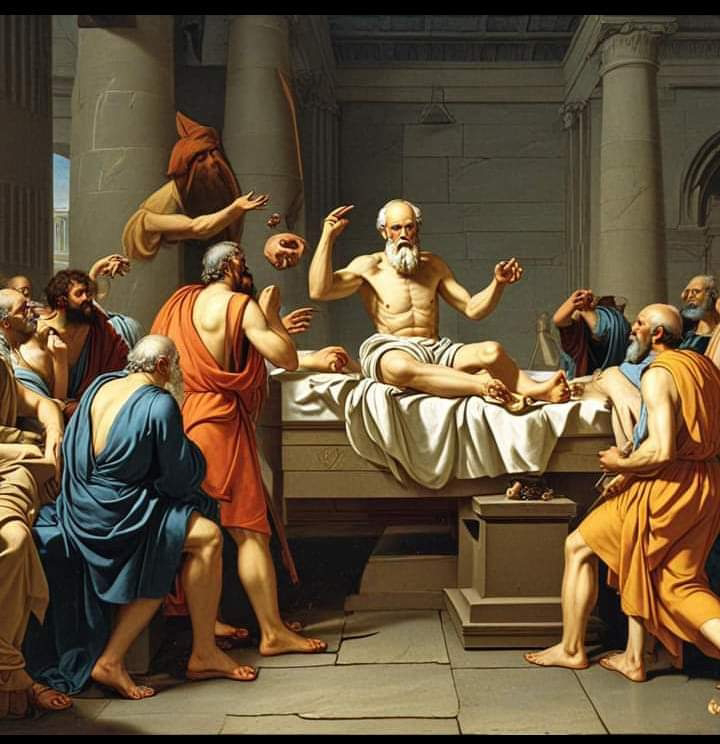
Trial and death of Socrates

The trial and death of Socrates, a pivotal event in Western philosophy, occurred in Athens in 399 BC. It marks a critical moment not only in Socrates' life but also in the history of philosophical inquiry, Athenian democracy, and the relationship between philosophy and society.

### Context

1. **Athenian Democracy**:
   - Socrates lived during the Golden Age of Athens, a period of cultural and intellectual flourishing. Athens was a democracy where citizens participated in decision-making through assemblies and courts.

2. **Socrates' Philosophy**:
   - Socrates was a philosopher who questioned conventional wisdom, seeking truth and ethical clarity through dialogue and the Socratic method (elenchus), a process of questioning assumptions and beliefs.

### Trial of Socrates

1. **Accusations**:
   - Socrates faced charges of impiety (not believing in the gods of the city) and corrupting the youth of Athens by encouraging them to question authority and traditional beliefs.
   - These accusations stemmed from Socrates' interactions with young Athenians and his critiques of Athenian politics and society.

2. **Legal Proceedings**:
   - The trial took place in the Athenian courts, with a jury of 500 citizens chosen by lot.
   - Socrates defended himself eloquently during his trial, as recorded by his disciple Plato in his dialogue "Apology."

3. **Verdict and Sentencing**:
   - Despite his defense, Socrates was found guilty by a narrow margin (around 280 to 220 votes).
   - When asked for an alternative punishment, Socrates suggested he should be rewarded for his service to Athens rather than punished. However, he was ultimately sentenced to death.

### Death of Socrates

1. **Execution**:
   - Socrates' death sentence was carried out by drinking a cup of poisonous hemlock (conium), a common method of execution in ancient Athens.
   - He calmly accepted his fate, refusing opportunities to escape and adhering to the laws of the city-state he had spent his life inquiring into and critiquing.

2. **Philosophical Legacy**:
   - Socrates' death became a symbol of intellectual integrity and the pursuit of truth, despite opposition from society and the state.
   - Plato's dialogues "Phaedo" and "Crito" recount Socrates' final conversations with his friends and disciples, discussing themes such as the immortality of the soul and the obligations of citizens to the state.

### Impact

1. **Philosophical Influence**:
   - Socrates' trial and death underscored the tension between individual conscience and societal norms, inspiring later philosophers to question authority and seek deeper understanding.
   - His legacy influenced the development of Western philosophy, ethics, and political thought, shaping figures like Plato and Aristotle.

2. **Political and Cultural Significance**:
   - The trial of Socrates highlighted the limits of Athenian democracy and the potential dangers of majority rule and populist sentiment.
   - It raised enduring questions about the role of dissent and intellectual freedom in democratic societies.

Friday, June 14, 2024

THE DIALOGUE OF PLATO AND SOCRATES


"THE ROLE OF TEACHER IN IGNITING THE FIRE OF KNOWLEDGE"

On a sunny afternoon in Athens, Socrates and Plato sat under an olive tree near the Academy, engaging in a deep discussion. They talk about education and role of teachers in guiding students.
Socrates who always uses his method of dialogue began to ask his students.
Socrates: "Plato, you have thought a lot about education. In your opinion, what is the most important role of a teacher in educating his students? "
Plato: "Teacher, I think the most important role of a teacher is to ignite the fire of knowledge in the soul of his students. Education is not just filling the head with facts, but inspiring and guiding them to search for their own truth. "
Socrates: "That was a deep thought. How do you think a teacher can light a fire? "
Plato: "A teacher must begin by recognizing the unique potential in each student. Each person's soul has the light of truth that can illuminate if given the right direction, according to their respective potential. Teachers must challenge their students to think critically, ask questions, and explore new ideas. "
Socrates: "As we do in this dialogue, yes? Encouraging critical thinking through questions? "
Plato: " Exactly, Teacher. Through dialogue, students learn not to take things for granted, but to explore and discover truths through arguments/discussion and evidence. This is the best way to attain true knowledge. "
Socrates: "However, what if the disciples choose to remain in darkness, refusing to receive enlightenment?" "
Plato: "That's the biggest challenge in education. Some may be comfortable in their ignorance. Our duty is to make them see that knowledge brings them to a better life. We must guide them patiently and show them the benefits of knowledge. "
Socrates: "Patience is essential, Plato. Patience is the power that withstands emotional turbulence and the temptation to surrender. A teacher must be patient in dealing with difficult students and persevere in educating them. "
Plato: " Correct, Master. A teacher needs to understand that every student has a different learning pace. Some may take longer to understand the concepts being taught. But with patience and support, they too will attain enlightenment/knowledge. "
The philosophy of this Dialogue describes Plato and Socrates' views on education, the role of teachers, and the importance of patience and enlightenment. Education is not merely about transferring knowledge, but about guiding and inspiring students to seek the truth and know themselves.
@pengikut