Showing posts with label Plato. Show all posts

Saturday, July 12, 2025

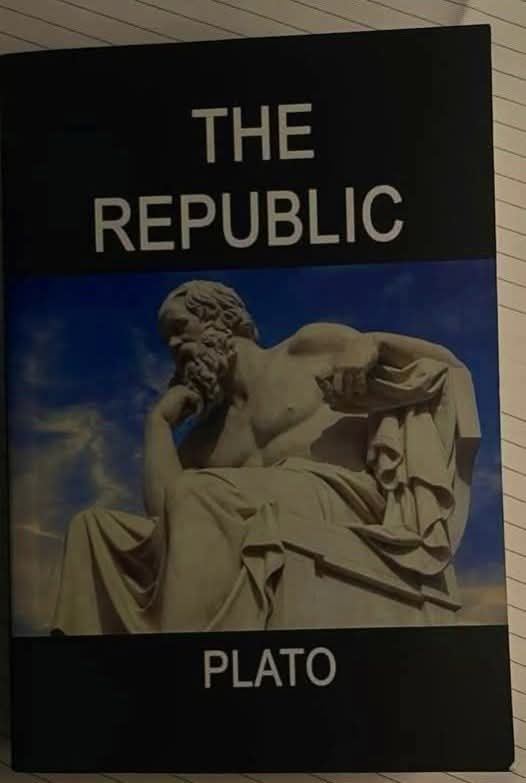
The Republic by Plato

There are books that speak plainly, others that argue, and then there are books that echo. The Republic by Plato does more than echo, it rings like a bell through the centuries, with each generation hearing its own questions and worries in the sound. To read it is to converse with one of the greatest minds to ever walk the earth. But more than that, it is to sit in a timeless court where the soul is on trial, where justice is not merely debated, but stripped naked, examined, reassembled, and exalted.

At first glance, it is a dialogue about justice. But justice here is not limited to law or punishment; Plato is after something deeper. What is justice in a person? In a society? How do we structure a life, or a state, that honors the good, the noble, the true? Socrates, Plato’s enduring voice and hero, pulls us along with questions, always questions: unrelenting, precise, frustrating in their clarity. And through this relentless questioning, the reader begins to sense a shift within: a quiet invitation to doubt what we thought we knew.

What makes this book so enduring is not that it gives answers, but that it forces the reader to confront their own assumptions. As Socrates debates with Glaucon, Adeimantus, and others, the city-state they build: the kallipolis becomes a mirror. Every structure, every class, every policy is built with a purpose: to reflect a well-ordered soul. The city is not just a metaphor. It is a map of the inner world. Plato is, quite literally, designing a republic inside you.

In this imagined city, people are divided into producers, auxiliaries, and guardians. The rulers, philosopher-kings, are chosen not for wealth or popularity, but for wisdom, discipline, and their capacity to love the truth. It is here that Plato makes one of his most provocative claims, that only philosophers, those who see beyond appearances, who love the Form of the Good, should rule. To the modern ear, this may sound elitist. But what Plato offers is not tyranny by scholars, but governance by those least likely to be corrupted by power.

Perhaps the most haunting section is the Allegory of the Cave, a philosophical parable that feels more like poetry. It speaks to anyone who has ever struggled to free themselves from ignorance or confronted uncomfortable truths. We are the prisoners, Plato says, chained to the wall, mistaking shadows for reality. The philosopher is the one who breaks free, sees the sun, and returns to rescue others. But the tragedy? The prisoners may kill him for it. This single allegory is enough to make The Republic worth reading.

But Plato does not just speak to the mind, he stirs the conscience. He warns of what happens when society prizes appearance over substance, pleasure over discipline, or individual desire over communal good. Democracies, he says, can decay into chaos if freedom is misunderstood as the right to indulge every whim. Tyrannies are born not from strength, but from the collapse of self-control. These warnings feel eerily modern. Our politics, media, and even personal lives often mirror the decline Plato describes.

And yet, despite its austere architecture, The Republic holds surprising tenderness. It touches on music, on education, on the role of women, even on the immortality of the soul. Plato insists that the soul’s health matters more than wealth or pleasure. He likens the unjust person to a city at war with itself: noisy, divided, exhausted. The just person, however, is like a well-tuned instrument: harmonious, steady, at peace. Is that not what we all seek? Not just to do right, but to be right, inwardly ordered, grounded in meaning?

As the dialogue winds down, Plato offers the Myth of Er, a strange tale of souls choosing their next lives after death. It feels mythological, yes, but also deeply psychological. The choices we make today, Plato suggests, echo beyond death. We shape our souls with every act of justice or injustice. Even now, in a world obsessed with speed and surface, that message lands with quiet power: you are crafting who you are becoming.

For all its seriousness, The Republic is not a cold book. It is rigorous, yes, but it burns with longing: for wisdom, for order, for a life that is not wasted. There is beauty in its ambition. Plato is not content to describe the world. He dares to reimagine it. And in doing so, he asks us to do the same.

There is no denying that the text can be dense. It requires patience, especially for readers new to philosophy. But the rewards are immense. You emerge from it changed, like someone who has traveled through a difficult country only to find themselves stronger, clearer, and strangely more whole.

It is not a book to be read once. It is a companion for life, one you return to at different seasons, hearing new wisdom each time. It challenges, yes. It even offends. But it also heals, confronts, and uplifts. It demands that you think not just about what kind of world you want to live in, but what kind of soul you want to inhabit.

To read The Republic is to face yourself. It is to sit in judgment not of others, but of your own integrity. And in that judgment, to find a quiet call toward betterment, toward justice not as law, but as harmony between what you know, what you believe, and how you live.

In our fractured world, full of distractions and dissonance, this book reminds us that clarity is possible. That justice is not dead. That philosophy, when rightly practiced, is not distant or dry, but deeply human.

Plato’s The Republic may have been written over two thousand years ago, but its questions are still ours. It is not just a work of philosophy. It is a work of the heart. Read it not to agree, but to awaken. And once awakened, let it disturb you, humble you, and draw you closer to the life that is truly worth living.

Friday, June 14, 2024

THE DIALOGUE OF PLATO AND SOCRATES


"THE ROLE OF TEACHER IN IGNITING THE FIRE OF KNOWLEDGE"

On a sunny afternoon in Athens, Socrates and Plato sat under an olive tree near the Academy, engaging in a deep discussion. They talk about education and role of teachers in guiding students.
Socrates who always uses his method of dialogue began to ask his students.
Socrates: "Plato, you have thought a lot about education. In your opinion, what is the most important role of a teacher in educating his students? "
Plato: "Teacher, I think the most important role of a teacher is to ignite the fire of knowledge in the soul of his students. Education is not just filling the head with facts, but inspiring and guiding them to search for their own truth. "
Socrates: "That was a deep thought. How do you think a teacher can light a fire? "
Plato: "A teacher must begin by recognizing the unique potential in each student. Each person's soul has the light of truth that can illuminate if given the right direction, according to their respective potential. Teachers must challenge their students to think critically, ask questions, and explore new ideas. "
Socrates: "As we do in this dialogue, yes? Encouraging critical thinking through questions? "
Plato: " Exactly, Teacher. Through dialogue, students learn not to take things for granted, but to explore and discover truths through arguments/discussion and evidence. This is the best way to attain true knowledge. "
Socrates: "However, what if the disciples choose to remain in darkness, refusing to receive enlightenment?" "
Plato: "That's the biggest challenge in education. Some may be comfortable in their ignorance. Our duty is to make them see that knowledge brings them to a better life. We must guide them patiently and show them the benefits of knowledge. "
Socrates: "Patience is essential, Plato. Patience is the power that withstands emotional turbulence and the temptation to surrender. A teacher must be patient in dealing with difficult students and persevere in educating them. "
Plato: " Correct, Master. A teacher needs to understand that every student has a different learning pace. Some may take longer to understand the concepts being taught. But with patience and support, they too will attain enlightenment/knowledge. "
The philosophy of this Dialogue describes Plato and Socrates' views on education, the role of teachers, and the importance of patience and enlightenment. Education is not merely about transferring knowledge, but about guiding and inspiring students to seek the truth and know themselves.
@pengikut

Wednesday, June 14, 2023

PLATO'S MOTIVATION TO HIS DISCIPLES


" The Real Wealth "

At the majestic Academy of Athens, Plato gathered with his students who felt anxious and pressured by the ambition to collect possessions. They believe that material wealth is the only path to happiness. Plato with wisdom and calmness, decided to invite them to contemplate the real meaning of wealth.
Plato: "My children, what do you think makes one rich? "
A young student answered confidently, "Teacher, of course property and money. The more we have, the richer we . "
Plato smiled and said, "Let's imagine a rich merchant in this city. He has a big house, a wide land and a lot of gold. However, because of his busyness, he almost has no time for his family, can't sleep well because he is always worried about his wealth, and has no friends because people only approach him for his wealth. Is he really rich? "
The students became silent, began to ponder the question. Another student, hesitantly, asked:
"So, Teacher, what makes a person really rich?" "
Plato replied softly: “True wealth lies in those things that money cannot buy. It is health, love, friendship, wisdom and peace in the heart. A farmer who has little but lives grateful, who has a family who loves him, and sleeps well every night without anxiety, is actually richer than an anxious trader. "
A female student looked confused and asked, "But, how can we feel rich if we don't have much wealth to satisfy our needs?" "
Plato: "Think of a teacher in a village who lives simply but is respected and loved by his students. Or a craftsman who feels good in his work and shares the happiness with his family. They feel satisfied and happy with what they have. True wealth is about having gratitude and happiness in your heart. "
Another student who was previously obsessed with luxury begins to understand and smile, feeling enlightened. "So, wealth is not about what we have, but about how we live our lives?" "
Plato: "Exactly on the spot. True wealth is the ability to enjoy life, to feel satisfied with what we have, and to use what we have for the good of others. A truly rich person is the one who has peace within himself and who can share happiness with others. "
Students begin to understand and feel light hearted. They realized that true wealth is not about the accumulation of property, but about happiness, gratitude, and kindness of heart.
The philosophy of this Story teaches us to see wealth as something more than just material. True wealth provides peace, builds gratitude, and motivates us to live more fully and meaningfully. By understanding this, we can face life with a positive attitude and use every opportunity to grow and share with others. ๐Ÿ‘‡๐Ÿ‘‡
(PLATO PHILOSOPHY GREEK THERE)๐Ÿ‘‡
@pengikut @sorotan